by Cynthia Tucker | May 27, 2026 | Perspective
Why Solid Results Can Hide What Performance Depends On
Solid results can mask what the organization is relying on to keep performance going.
The work gets done. Customers are served. The numbers hold. Key priorities continue to move.
But underneath, performance may be depending on patterns that were never meant to become the way the business operates: constant translation, extra follow-up, too much senior attention, informal workarounds, and repeated effort to hold together what the organization has not yet built the capacity to carry on its own.
That is the pattern many leadership teams are already operating inside.
It is also one of the hardest to name, because the numbers may not show it yet.
The question is not only whether performance is holding. It is what performance is depending on.
The Cost That Doesn’t Show Up in the Numbers
One of the hardest issues to diagnose in a growing mid-sized company is not always underperformance.
It is solid performance while the way the business works quietly falls behind what growth, complexity, or change now requires.
- A company can keep hitting its numbers while becoming harder to lead.
- A strategy can seem clear while execution depends on constant translation.
- A leadership team can believe the organization is aligned while the people doing the work experience confusion, rework, and delay.
The business may be succeeding. But it may be producing that success at a cost that does not appear in a financial report.
Executives rightly pay attention to outcomes: revenue, margin, customer retention, execution milestones. The problem is that outcomes can obscure what it takes to produce them.
That hidden cost often shows up first in how work actually moves.
- Decisions that belong closer to the work keep moving upward.
- Coordination depends on relationships instead of reliable ways of working.
- Accountability is discussed often but still depends on repeated follow-up.
- Priorities move, but only because someone keeps translating what they mean.
By the time the cost shows up clearly in the numbers, leaders may no longer be solving the original issue. They may be solving the cost of having waited.
That means the moment to pay attention is not only after performance slips. It is while performance still holds, because solid results can make the underlying reliance harder to see.
When Effort Starts to Look Like Capability
In many growing mid-sized companies, performance keeps moving because capable people keep stepping in to translate priorities, chase follow-through, and close gaps that the business has not yet built into its normal ways of working.
That effort is real. It matters. But it creates a risk many organizations do not name accurately.
When results depend on people repeatedly stepping in, the business can begin to mistake that effort for strength.
This is why the pattern can be difficult for strong leaders to see. The effort is working, so the business keeps trusting it. But performance may be relying on people repeatedly stepping in where roles, routines, and decisions are not yet reliable.
Over time, that dependency starts to feel normal. Individual effort starts to look like operating rhythm. Compensating starts to look like capability.
What Performance May Actually Be Depending On
When results are solid, leaders may not question what is sustaining them. That is exactly when the question matters most.
- Performance may be depending on senior leaders who keep clarifying priorities because strategic direction is not translating cleanly into execution.
- It may also be depending on informal relationships and institutional memory because decision rights are not explicit enough for work to move reliably without them.
- Or on personal follow-up because accountability is discussed often but not built into how work is structured, measured, and reinforced.
- Or on urgency (deadlines, escalations, and pressure) because priorities, ownership, and operating rhythms are not being resolved clearly enough in the normal flow of work.
- Or on cross-functional goodwill that works under normal conditions but starts to fracture under growth, pressure, or competing priorities.
None of these dependencies means the organization is broken. But each one tells leaders something important: current performance may be relying on patterns that will not hold at the next level of complexity.
Why the Usual Fixes Don’t Hold
When friction becomes visible, leaders usually reach for recognizable solutions:
- Too much senior involvement becomes a delegation conversation.
- Uneven accountability becomes a need for clearer expectations.
- Slow execution leads to more meetings, dashboards, or operating-cadence discussions.
- Misalignment leads to another round of alignment work.
- Each response may be reasonable. None is inherently wrong.
The problem is that the visible symptom is rarely the actual constraint.
Leaders address what is visible because the symptom is in front of them. The constraint is often harder to see. It lives in how decisions are made, how ownership is defined, how accountability is reinforced, and how work moves across the business when complexity increases.
That is why the same problem can return with a different name.
The delegation conversation from last year becomes the accountability conversation this year. The accountability conversation becomes the alignment conversation next year.
Each fix addresses part of the presenting issue. None addresses what keeps producing it.
Partial fixes can also create a false sense of resolution. A targeted intervention may improve one surface of the problem. Leaders may believe the issue has been solved. Then the same pattern returns somewhere else.
Over time, the business becomes more accustomed to the workaround than to the underlying gap.
The Question That Changes the Diagnosis
The most useful question is not simply: what is the problem? That question matters, but it can keep leaders too close to the presenting issue.
The sharper question is: What is performance currently depending on that the organization has not yet built the capacity to sustain?
That question changes the diagnosis.
If performance depends on senior leaders absorbing decisions that should be owned elsewhere, the work is not simply delegation. It may require clearer decision architecture: who owns what, at what threshold, with what accountability for the outcome.
If performance depends on people chasing follow-through after commitments are made, the work is not simply more check-ins. It may require building accountability into how work is structured, measured, and reinforced.
If performance depends on individual steadiness under pressure, the work is not simply asking leaders to stay calm and focused. It may require strengthening leadership capacity: how leaders interpret pressure, what their behavior signals, and whether the business reinforces the behavior it needs.
If performance depends on personal relationships and goodwill because cross-functional coordination is not yet reliable when pressure increases, the work is not simply relationship building. It may require mechanisms that make coordination less dependent on personality and personal history.
That is the diagnostic shift.
The work is to determine what is actually shaping the outcome: individual behavior, team dynamics, decision-making, accountability, operating rhythm, or the recurring patterns in how work moves when complexity increases.
With the right diagnosis, leaders can see what performance is relying on, what that reliance is costing, and what must be built or strengthened so the business is not carried by conditions that may not hold as complexity increases.
What to Notice Before Performance Slips
The goal is not to treat every sign of friction as a crisis. Some escalation is appropriate. Some senior involvement is necessary. Growth creates legitimate demands on leadership.
The work is to distinguish normal executive involvement from structural dependency.
- Are decisions escalating because judgment is required, or because ownership is unclear?
- Is senior involvement needed because the issue is strategic, or because decision ownership below that level has not been made clear?
- Are operating rhythms moving work forward, or mainly surfacing where things stand?
- Is accountability built into how work moves, or does it depend on repeated personal follow-up?
- Is performance being sustained by clear roles, routines, and decision mechanisms, or by people repeatedly stepping in where those mechanisms are not yet reliable?
The answers to these questions give leaders a clearer picture of what performance actually depends on.
They also reveal whether those dependencies are likely to hold as the business grows, changes leadership, enters a new market, integrates an acquisition, or faces sustained complexity.
Where the Necessary Work Begins
A company can be performing and still be outgrowing what makes performance reliable.
A leadership team can be strong and committed and still be compensating for ways of working that have not kept pace with what the business now requires.
A strategy can be clear at the top and still lose traction in execution because the organization has not built the mechanisms to carry it consistently.
The issue is not whether people are working hard enough. The issue is whether the business has built the decision-making, accountability, coordination, and leadership capacity required to sustain what performance now depends on.
That is where the work begins: understanding what the business is relying on today, what those dependencies reveal, and what must be strengthened so the organization can carry what comes next.
The business that is performing today and the business that can sustain performance through what comes next are not always the same organization.
The distance between them is what the work addresses.
An Invitation
Whether performance is still holding or momentum is beginning to slow, the question is the same:
What does performance actually depend on?
The answer is rarely visible in the numbers at first. It shows up in how work moves under pressure and in what it takes to keep it moving.
The earlier leaders understand what performance is relying on, the clearer it becomes what must be built or strengthened so the business can sustain performance and carry what comes next.
Start the Conversation →

by Cynthia Tucker | Mar 31, 2026 | Perspective
Leaders say focus matters. Then they add more priorities.
They ask for ownership. Then they step in early, or stay closer to the work than their teams expected.
They ask for speed. Then they add approvals, or react in ways that make the next decision feel less safe.
Teams do not miss this. They adapt to it. And the adaptation, not the intent but the behavior, is what shapes how the organization actually operates.
That gap between what leaders intend and what organizations absorb is one of the most consequential and most misattributed dynamics in mid-sized companies. It is almost always something structural; a leadership system that has not deliberately aligned leadership intention and behavior. And because the symptoms are visible before the source is understood, the cost compounds before it is correctly identified.
The Gap Between Belief and Behavior
Most leaders don’t intend to send mixed signals. Mixed signals come from a gap between what a leader consciously believes and what their behavior, especially under pressure, repeatedly teaches.
A leader genuinely believes in ownership. Under pressure, the instinct to protect performance overrides that belief, so they step in, redirect, or correct too soon. The intention was never to undercut ownership. But that is what the organization learned.
A leader genuinely believes in focus. Under pressure, every urgent issue feels like a legitimate exception, so exceptions accumulate until focus exists more as language than operating reality. The intention was never to dilute priorities. But that is what the behavior produced.
Some mixed signals are obvious. The behavior is specific, visible, and traceable to a particular source. Those cases, while real, are not the harder problem.
The harder and more common problem is the leader who is trying to lead well and whose behavior, in aggregate, is producing a different organization than the one they are trying to build.
The gap is between what leaders intend and what the organization actually learns from their behavior.
Why This Lands Harder in Mid-Sized Companies
In a large enterprise, layers, specialization, and institutional momentum can absorb some of this inconsistency. Execution may slow, but it often keeps moving.
In a company with 200, 500, or 900 employees, there is far less buffer. Leadership behavior is visible, interpreted quickly, and calibrated constantly by people who know that understanding what leadership actually wants is essential to getting work done.
When leadership signals are inconsistent, the organization does not simply become uncertain. It becomes careful in all the wrong ways. People check more, escalate sooner, document more, and act less. They spend energy reading leadership rather than moving work.
The cost is not merely cultural. It is operational. Decision velocity drops. Cross-functional friction rises. Ownership weakens at the edges. Rework increases because people optimize for safety rather than clarity. Execution becomes more dependent on leader intervention at precisely the stage when the business needs the organization moving with confidence and acting from a shared understanding of what actually matters.
The company still executes. But it moves with more friction, less confidence, and less predictability than growth can afford.
What the Pattern Actually Looks Like
Five signals recur often enough that I have stopped being surprised by them. They often appear in this order, each one compounding the cost of the ones before it.
“Stay focused” while continuing to add priorities
This is often the first signal to erode. Leaders talk about focus, then continue introducing new requests, parallel initiatives, and urgent exceptions that pull attention away from what they just called primary.
Teams learn quickly: priorities are not truly real.
The result is not just that people have too much to do. It is the loss of organizational confidence in what leadership actually means when it names a priority. And once that confidence erodes, every subsequent directive becomes slightly less credible.
“Take ownership” while staying too involved
When people no longer trust what leadership calls a priority, ownership becomes harder to locate.
Leaders who genuinely want their teams to take ownership often find themselves, under pressure, moving closer to the work: reviewing more often, redirecting decisions, or correcting course without explanation.
Over time, people stop trusting where their authority begins and ends. They wait longer, check more often, and protect themselves earlier. What looks like caution is often an adaptation to ambiguity that leadership itself has reinforced.
“Move faster” while making action feel riskier
Speed requires clarity and enough psychological safety to act.
When leaders change direction without explanation, revisit decisions unpredictably, or react inconsistently when problems surface, teams compensate by slowing down. They add checkpoints, seek cover, and involve more people than the work actually requires.
What appears to be resistance or bureaucracy is often rational adaptation to an environment in which moving fast has produced unnecessary exposure.
“Accountability matters” while applying it unevenly
This is the signal that damages trust most durably.
When standards are enforced in one area and quietly relaxed in another. When some missed commitments are addressed and others are tolerated for political, historical, or personal reasons. People notice.
Once accountability feels conditional, expectations become unstable. Execution becomes less reliable not because people do not care, but because they no longer trust the standard enough to organize their behavior around it.
“Work together” while rewarding heroics over coordination
This signal is often the most invisible.
Organizations say they value collaboration, but many still reward the visible rescuer, the last-minute fixer, or the person who solves it alone. Collaboration may be the language. Heroics remain the path to recognition.
The business pays for that contradiction through fragmentation, duplicated effort, loose coordination that compounds as the organization grows, and a form of dependency that becomes more expensive over time.
Why Pressure Makes This Worse, Not Better
The natural assumption is that experienced leaders become steadier under pressure. In practice, the opposite is often more likely.
When demands rise and stakes increase, cognitive bandwidth narrows. Attention becomes more selective. Tolerance for ambiguity drops. The impulse to step in, control outcomes, and reduce uncertainty through direct involvement rises with it.
That is not merely a mindset issue. Under pressure, people tend to rely more heavily on familiar patterns, threat detection, and fast protective responses. Developmental psychology adds an important layer here: when complexity rises, leaders do not always operate from their most advanced commitments. They often fall back on the assumptions and habits that feel safest, fastest, and most self-protective in the moment.
That is why leaders who value empowerment can become more controlling precisely when empowerment is most needed. Leaders who value focus create more exceptions precisely when focus is most expensive to lose. Leaders who want accountability avoid hard calls precisely when the system most needs to see what accountability actually means.
That gap between intention and behavior, especially under pressure, sits beneath many of these patterns.
Self-mastery is central to this. Not self-mastery in the motivational sense, but in the more precise one: the capacity to notice what is actually governing your behavior under pressure and to lead from intention rather than instinct when it matters most.
Without that awareness, every other leadership skill becomes conditional. It works until pressure exposes what is really running the system.
The Structural Dimension
Individual behavior matters. Some mixed signals do trace directly to specific leaders whose habits or blind spots need to be addressed directly.
But when the pattern is organization-wide, persists across personnel, and survives team changes and offsite resets, the source is usually not the people. It is the system they are operating inside.
The leadership system, the operating norms governing how priorities are set, decisions are made, accountability is applied, and behavior under pressure is modeled and absorbed, shapes what everyone in the organization learns is actually expected of them. Not what is stated but what is reinforced.
The formal elements may exist: leadership principles, operating frameworks, defined priorities. What they rarely account for is the informal system that forms alongside them and governs behavior as the organization grows and complexity increases.
When that is the constraint, better communication does not reach it. Isolated interventions may shift behavior temporarily. Left unchanged, the system pulls behavior back toward its existing norms.
What resolves it is making the system explicit. Understanding what norms are actually governing behavior throughout the organization, and building deliberately toward what the business now needs.
The Question Worth Sitting With
There is one diagnostic question that cuts directly to the source of this issue:
Are the signals your leaders are sending aligned enough that people throughout the organization can act with confidence or are they spending energy interpreting, checking, and protecting themselves instead?
When signals are not aligned enough for people to act with confidence, the business pays through slower decisions, weaker ownership, greater dependence on top leaders, lower execution predictability, and organizational drag that is real and measurable, even when it is rarely named correctly.
Mixed signals are not a soft issue. They are not a messaging issue. And they are rarely solved by asking leaders to communicate more clearly.
They are evidence that the leadership system is teaching one set of lessons while leadership language announces another.
That is the real risk.
Because when leadership signals are not aligned enough to act on, the organization does not simply get confused. It reorganizes itself around caution, interpretation, and self-protection and in doing so, embeds the very behaviors that make the cost harder to see, slower to name, and more expensive over time.
That is why the effects compound.
An Invitation
When what leaders intend and what their behavior teaches begin to diverge, the organization learns from the behavior.
People start reading the pattern: what gets rewarded, what creates risk, and what actually moves forward. Over time, that can slow decisions, soften accountability, and make execution depend more on interpretation than clarity.
That is the moment to look more closely at the signals shaping how people act under pressure: what is said, what is modeled, and what quietly gets protected.
The question is not only, “Are we aligned?” It is, “Are our leadership signals clear enough for people to move with confidence in the direction leadership intends?”
If that question feels relevant to what your organization is navigating, start the conversation.
→ Start the Conversation
→ Explore Lead for Alignment

by Cynthia Tucker | Feb 24, 2026 | Perspective
Artificial intelligence (AI) has accelerated the speed, scale, and accessibility of information across organizations. Analysis that once required weeks now surfaces in moments. Options emerge before teams have fully framed the questions they are trying to answer. Multiple viable paths surface quickly, often presented with analytical confidence that signals readiness for action, increasing pressure to commit before shared alignment has fully formed.
AI’s most consequential impact is not only technological. It is human.
AI delivers meaningful gains in insight and efficiency. Yet its impact on organizational performance ultimately depends on something more fundamental: how leadership systems interpret, align, and act on what expanded capability makes possible.
As AI expands what organizations can generate, model, and execute, expectations for faster response often follow. In this environment, AI functions not only as technological acceleration, but as a stress test. In well-designed leadership systems, expanded capability sharpens clarity and strengthens execution. In less aligned systems, it exposes gaps, revealing whether rising complexity can be absorbed without fragmenting alignment or degrading performance.
Here, leadership system refers not to technology, but to the organizational architecture: the structures, decision rights, accountability mechanisms, and operating norms through which leaders interpret information, align priorities, and translate direction into coordinated execution.
In many organizations, AI increases the volume and velocity of information faster than leadership systems were designed to translate it into aligned execution.
The Disappearing Space for Judgment
Historically, leadership operated with natural pauses: time to debate options, test assumptions, and build conviction before committing resources.
When analysis becomes instantaneous, those pauses can disappear. Insights surface quickly. Options proliferate. Expectations for rapid response accelerate. Recommendations may emerge simultaneously, sometimes pointing in different, yet analytically defensible, directions.
Speed itself is not the issue. Tension emerges when decisions move forward before leaders have adequately examined tradeoffs, weighed second-order consequences, and tested assumptions under pressure.
Leaders do not operate with unlimited cognitive bandwidth. As decision cycles shorten and information volume increases, attention narrows and tradeoffs become harder to evaluate particularly when stakes are high.
Judgment forms in the space between thinking and acting. That space has always been consequential. It is where leaders weigh competing priorities, test coherence, surface second-order consequences, and build conviction around a course of action.
When that space narrows beyond what disciplined evaluation requires, organizations may move quickly, but without the shared clarity needed to sustain alignment and performance.
Signals that decision velocity may be outpacing disciplined judgment include:
• Reduced scrutiny of core assumptions
• Deferred resolution of strategic tradeoffs
• Escalating rework, reversals, or cross-functional friction
With real implications for long-term performance.
When Leadership Capacity Becomes the Constraint
AI reduces many traditional analytical bottlenecks: access to data, processing speed, operational efficiency, predictive modeling.
What remains inherently human is interpretation — discerning what insight means in light of strategic priorities, what merits action, what is noise, what may be flawed, and which consequences the organization is willing to carry.
As analytical and operational capability expand, performance increasingly depends on the organization’s capacity to interpret, align, and decide under pressure.
Research in developmental psychology suggests that leaders vary in their capacity to integrate complexity and ambiguity.
Some can hold ambiguity, weigh competing signals, and resist the pressure to decide prematurely. Others experience greater difficulty doing so.
When leaders are required to process more information, and to do so more quickly than they can thoughtfully weigh and align around it, shared understanding can begin to weaken. Accountability may blur. Teams may generate differing conclusions from similar questions depending on prompts or inputs — slowing interpretation and execution.
This is where AI reveals differences in leadership capacity with direct implications for alignment, decision quality, and performance.
Like any stress test, AI does not create structural weakness; it reveals where existing systems lack the capacity to absorb additional complexity.
The Emerging Risk: Confidence and Ownership
As AI embeds into workflows, its impact extends beyond information access, analysis, and strategic recommendations. It shapes how problems are framed, which options surface first, and how risk is evaluated.
Research on automation bias suggests that consistent reliance on AI-generated recommendations can subtly influence how individuals calibrate confidence in their own reasoning. As AI-generated recommendations become embedded in daily workflows, they can begin to carry an implicit presumption of credibility. Human interpretation remains central, but it may be exercised with less conviction.
Over time, this can reduce the rigor with which assumptions are challenged and tradeoffs are examined. Teams may interrogate AI-informed outputs differently than they would have prior to their introduction — subtly reshaping how challenge and debate unfold inside organizations.
As AI informs more recommendations and operational activity, accountability can also blur. Important questions surface:
- Who owns interpretation?
- Who validates recommendations?
- Who carries consequence for AI-informed decisions?
Accountability cannot transfer to AI, even as analytical and operational execution become increasingly automated. Responsibility for interpretation, alignment, and consequence remains with leaders.
Why This Pressure Emerges Faster in Mid-Sized Companies
Large enterprises often operate with structural buffers: specialized analytic functions, layered governance processes, and dedicated strategy teams that help absorb and align around rising volumes of AI-generated insight.
In many mid-sized companies, fewer structural layers separate analysis from execution. Spans of control may be broader. Governance layers are often lighter. In these environments, insight can move more directly into implementation, sometimes before shared understanding has fully taken hold.
In AI-accelerated environments, these structural differences can make demands on alignment and decision architecture more immediate, and their weaknesses more visible.
Alignment Converts Capability into Performance
In AI-enabled environments, analytical capability and available options are abundant; shared understanding does not automatically keep pace.
Alignment is present when organizations operate from a shared understanding of what the insight means, and when that insight translates into clear direction and coordinated execution.
When alignment weakens:
- Strategic priorities lose coherence across levels
- Resource allocation diffuses
- Cross-functional friction increases around interpretation and ownership
- Execution fragments
The consequences are rarely immediate. More often, a widening gap emerges between strategy, decisions, and action.
Organizations begin spending more energy reconciling interpretations than advancing strategy.
As insight expands, the discipline of choosing what not to pursue becomes as important as what to act on.
Over time, expanding AI capability without strengthening leadership systems compounds these effects, eroding strategic coherence and increasing performance variability when leadership systems do not evolve alongside it.
What Leadership Now Requires in the Age of AI
AI does not change leadership’s mandate. It intensifies the conditions in which leadership must be exercised.
The answer is not to resist adopting AI. It is to strengthen the leadership system that converts expanded capability into aligned execution.
Leading effectively in this environment requires deliberate leadership architecture that protects judgment, clarifies ownership, and anchors enterprise priorities under pressure. Without these disciplines, expanded capability does not reliably translate into stronger decisions or sustained performance.
Preserve Space for Judgment
Build deliberate decision processes that protect reflection, scenario testing, and downstream consequence evaluation before acting on AI-generated recommendations.
Define Who Makes Sense of the Insight
Establish clear responsibility for translating analysis into strategic meaning and shared direction before action is taken.
Reinforce Enterprise Priorities Relentlessly
Anchor attention on what matters most so proliferating insight does not fragment focus or dilute resource allocation.
Make Decision Accountability Explicit
Ensure it is unmistakably clear who owns decisions and who carries responsibility for their consequences.
Sustain Independent Judgment
Strengthen leaders’ capacity for independent reasoning rather than allowing analytical outputs to become default assumptions.
Govern Decision Tempo
Align speed with consequence, slowing where risk is high.
Develop Leaders Who Can Integrate Complexity
Develop leaders capable of holding ambiguity, weighing competing signals, and translating accelerated insight into coherent action.
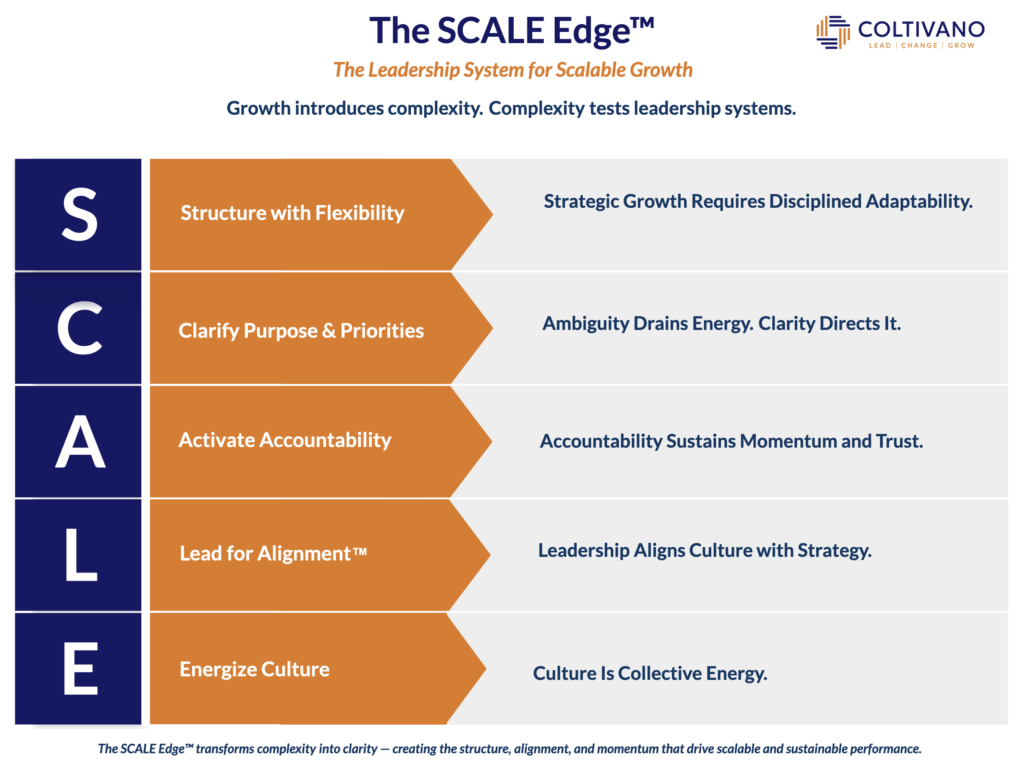
Within The SCALE Edge™, The Leadership System for Scalable Growth, these disciplines are expressed through structure with flexibility, clarity of purpose and priorities, activation of accountability, leading for alignment, and energizing culture as complexity rises.
AI does not introduce new leadership principles. It amplifies the consequences of neglecting them.
The Shift, Clearly Stated
AI expands what organizations can analyze and execute. It does not automatically strengthen the shared judgment required to align around what matters most. In the age of AI, leadership effectiveness depends on the ability to create clarity, sustain confidence, and coordinate aligned action when information moves faster than collective interpretation.
Organizations that scale AI successfully will not be those with the most advanced systems alone, but those whose leaders evolve the structures and disciplines required to translate accelerated insight into sustained, aligned performance.
An Invitation
As AI expands what organizations can see, generate, and act on, it also raises the standard for leadership judgment, decision discipline, and organizational readiness.
The technology may accelerate capability, but it does not automatically create clarity, accountability, or coordinated execution. Those still have to be led, designed, and reinforced.
The question is not only, “How do we use AI?” It is, “Is the organization ready to carry the speed, complexity, and decisions AI makes possible?”
If that question feels relevant to what your organization is navigating, start the conversation.
→ Start the Conversation
→ Explore The Coltivano Executive Intensive™

by Cynthia Tucker | Dec 20, 2025 | Perspective
Growth exposes what the organization has outgrown.
As companies scale, the habits that once created speed can begin to strain under complexity. Leaders work harder. Teams move with more effort. Decisions slow. Accountability becomes less consistent. Culture becomes more reactive than generative.
Every organization reaches moments when its existing leadership and organizational capacity can no longer carry what growth now requires. What once worked through proximity, instinct, and individual effort now requires greater clarity, stronger accountability, more deliberate alignment, and practices that help performance hold as complexity increases.
These moments are not signs of failure. They are signs of exposure. Growth, change, or stalled momentum can reveal where familiar ways of operating no longer generate the progress they once did.
Neuroscience helps explain part of the pattern: under cognitive load or pressure, the brain tends to default to familiar responses, even when those responses are no longer effective. But recognition is not resolution. Once the pattern is visible, leaders must do something more consequential:
Evolve the system that leads.
This article explores what that evolution requires — and why organizations that intentionally strengthen the capacity behind performance are better positioned than those relying on effort alone.
Why Leadership and Organizational Capacity Must Evolve as Companies Grow
As organizations scale, three forces intensify simultaneously:
1. Complexity Outpaces Structure
Growth multiplies interdependencies. Decisions that used to be simple now carry broader consequences. Without stronger clarity, prioritization, and shared decision discipline, leaders can default to individual judgment rather than collective alignment.
2. Velocity Exposes Bottlenecks
Momentum begins to slow when decision rights are unclear, priorities compete, accountability is inconsistent, or conflict remains unaddressed.
Neuroscience shows that under cognitive load or pressure, the brain defaults to familiar patterns, even when those patterns are no longer effective.
3. Culture Reflects and Amplifies Leadership Gaps
Culture becomes noisy when leadership signals are inconsistent. As research frequently highlighted in Harvard Business Review has shown, people rely on coherence (alignment between intention, behavior, and communication) to build trust, commit fully, and perform at their best.
Organizations can change through pressure or circumstance, but they evolve sustainably only when leadership and organizational capacity keep pace with rising complexity.
The Work of Evolution: What Changes as Leadership Evolves
Leadership evolution is not simply about becoming better leaders. It is about creating the conditions where better leadership becomes possible at every level of the organization.
Across mid-sized companies, the most consequential shifts occur in four areas:
1. Moving from Individual Effort to Shared Capacity
Early-stage momentum often comes from the force of individual leaders: skill, drive, intuition.
But as complexity increases, what the organization needs is not more individual effort. It needs shared capacity: clearer priorities, distributed ownership, stronger alignment, and the ability to execute without constant escalation.
- Heroics → Shared ownership
- Intuition → Clear direction and structure
- Proximity-based alignment → Alignment that can travel across the organization
This transition is one of the most challenging, and transformative, for executives in mid-sized organizations, where clarity must travel quickly and decisions ripple widely.
2. Shifting From Tactics to Priorities That Anchor the Organization
When everything feels important, nothing is. Evolving leadership systems strengthen strategic clarity:
What matters most right now?
What is the work that moves the organization forward?
What must stop, or change, for progress to accelerate?
This shift enhances cognitive efficiency. It reduces noise, conserves energy, and directs attention toward what actually drives performance, especially in organizations where resources, layers, and time are limited.
3. Building Accountability That Enables, Not Polices, Performance
In organizations stuck between stages of growth, accountability often becomes reactive: escalation loops, overloaded leaders, unclear ownership.
In evolved leadership systems, accountability becomes a source of momentum, not pressure. Neuroscience and developmental psychology demonstrate that:
Clear expectations + visible progress + meaningful autonomy > sustained motivation, trust, and performance.
In mid-sized companies, where role clarity and decision ownership must be visible and distributed, this shift becomes foundational.
When accountability evolves, decision-making accelerates. Execution strengthens. Teams regain confidence.
4. Cultivating Culture as an Energy System; Not an Engagement Campaign
Organizations don’t scale on engagement initiatives. They scale belief, behavior, and connection. Evolved leadership systems create conditions where:
- People understand the purpose and strategy
- Leaders model coherence across decisions
- Teams feel connected to the work and to each other
This alignment generates cultural energy, one of the strongest predictors of sustainable performance.
The Moment Leaders Know the System Must Evolve
Across work in mid-sized organizations, a consistent pattern signals a leadership inflection point.
- “Everything feels harder than it should.”
- “We’re working more, but not moving faster.”
- “The same issues keep resurfacing.”
- “Clarity isn’t traveling the way it used to.”
- “Our culture is shifting in ways I can’t quite articulate.”
- “People aren’t aligned, even when they believe they are.”
These symptoms are real, but they are rarely the whole story. They often point to something deeper in how priorities move, accountability holds, decisions get made, and the organization builds the capacity to perform at the next level.
How Leadership Evolution Actually Begins
Leadership and organizational capacity strengthen through three disciplined commitments. Together, they separate organizations that scale sustainably from those that stall.
1. The Commitment to See Clearly
Leaders step back from symptoms to examine the system:
- How decisions are made.
- How accountability operates.
- How culture transmits energy and expectation.
- How clarity does, or does not travel.
2. The Commitment to Align Intentionally
They create coherence between purpose, strategy, structure, and behavior so the organization receives one clear leadership signal.
3. The Commitment to Build Leadership and Organizational Capacity
Not as coaching alone, not as training alone, but as the work of strengthening how the organization leads, decides, aligns, and performs.
This is the work that transforms pressure into progress and unlocks what becomes possible when leadership evolves together.
When leaders integrate insights from neuroscience, developmental psychology, and leadership experience, they build systems capable of sustaining clarity, coherence, momentum, and performance as complexity rises.
Why This Matters Now
Mid-sized organizations experience demanding leadership inflection points as they grow.
- They must scale while asking more of leaders and their teams at every level of the organization.
- They must make complex decisions faster.
- They must maintain culture during expansion or strategic change.
- And they must do this while preserving what makes them distinct.
All while sustaining performance, decision velocity, and execution quality under increasing pressure.
Strengthened leadership and organizational capacity becomes the differentiator.
It becomes the advantage competitors cannot replicate because it is built from the inside out, through clarity, alignment, accountability, and cultural energy.
When leaders strengthen the capacity behind clarity, accountability, alignment, and connection, organizations can unlock momentum that effort alone cannot produce.
When leaders recognize these moments not as setbacks but as signals, evolution becomes possible.
An Invitation
If the organization is working harder but not moving with greater clarity, speed, or confidence, it may be that the capacity behind performance has not evolved with the complexity the business now carries.
That is the moment to look more closely at how priorities are set, how decisions move, how accountability holds, and how leaders create coherence beyond their own direct reach.
The question is not only, “How do we get more from the current system?” It is, “What must evolve so the organization can perform at the next level?”
If that question feels relevant to what your organization is navigating, start the conversation.

by Cynthia Tucker | Oct 25, 2025 | Perspective
“Culture does not shift through slogans. It shifts when belief, behavior, and the way people work together reinforce what performance depends on.” – Cynthia Tucker, Founder & Managing Director, Coltivano™
Culture as an Energy System
In mid-sized organizations navigating growth, complexity rises quickly and culture becomes the system through which belief, behavior, and connection are either reinforced or strained. When that system isn’t intentionally shaped, momentum thins, focus drifts, and execution becomes heavier than it should.
In growing organizations, culture often becomes the invisible force that either accelerates or constrains performance. It’s not just what people believe it’s how those beliefs drive behavior, decisions, and accountability every day.
As growth adds layers of complexity, cultural energy can fragment. Silos form, ownership diffuses, and initiative fades. The question isn’t whether culture exists. It’s whether it’s aligned, energized, and advancing the organization’s goals.
From Engagement to Energy
Traditional culture work often focuses on engagement: how people feel about their work. But engagement alone isn’t enough. Sustainable performance comes from energy, the dynamic alignment of purpose, autonomy, and collective accountability.
Neuroscience reinforces this: when people experience autonomy, competence, and relatedness, motivation and focus rise. When leaders design systems that reinforce these needs, cultural energy compounds rather than dissipates.
This energy is not abstract. Research shows that organizations with strong alignment and psychological safety convert more discretionary effort into productive output and innovation (McKinsey, 2024). When energy aligns, effort amplifies not because of pressure, but because purpose and accountability move in the same direction.
Energizing culture, therefore, isn’t about enthusiasm. It’s about creating the conditions that sustain intrinsic motivation, shared ownership, and clarity of purpose.
The Cultural Operating System
At Coltivano, we describe culture as an operating system. The underlying logic that shapes how people think, decide, and collaborate. To scale effectively, that operating system must evolve as the organization does (see Structure as Strategy article).
A high-performing culture rests on three reinforcing elements:
- Clarity: shared understanding of purpose, priorities, and performance expectations.
- Coherence: alignment between what leaders say, do, and reward.
- Connection: trust, respect, and collaboration that strengthen engagement and speed execution.
When these three are strong, culture becomes self-reinforcing, a source of energy rather than exhaustion.
Energizing Through Leadership
Leaders don’t control culture. They conduct it. Every decision, conversation, and structure either amplifies or diffuses energy.
Neuroscience shows that leadership presence shapes collective emotion and focus. Through emotional contagion and neural mirroring, well-established phenomena in social neuroscience, leaders influence the cultural “climate” of an organization. When they model calm under pressure, clarity under ambiguity, and accountability in action, that coherence cascades across teams.
Energized cultures emerge when leadership systems integrate belief, behavior, and connection into how work gets done:
- Behavior demonstrates ownership and accountability.
- Belief reflects the shared conviction that purpose and strategy are credible, actionable, and worth committing to.
- Connection strengthens psychological safety and trust, foundational conditions for innovation and adaptability.
When these elements synchronize, culture transforms from something leaders manage to something the organization embodies.
From Culture to Performance
Culture becomes a competitive advantage when it turns alignment into momentum. Teams execute faster. Communication becomes clearer. Strategy translates into coordinated action.
This reflects a core principle in Coltivano’s advisory work: culture is not separate from performance. It is one of the ways leadership intent becomes shared behavior, reinforced norms, and coordinated execution.
Closing Insight
Culture is not what an organization says, it’s what it sustains. Energizing culture means ensuring the energy that drives growth doesn’t erode under complexity.
An Invitation
If culture feels harder to hold as the business grows, belief, behavior, and accountability may no longer be reinforcing one another clearly enough for the organization’s current complexity.
That is the moment to look beyond culture language and examine what is actually being reinforced — how leaders behave under pressure, how ownership holds, and how people experience connection to the work and to one another.
The question is not only, “How do we improve culture?” It is, “What must be reinforced so culture becomes a source of performance, not drag?”
If that question feels relevant to what your organization is navigating, start the conversation.
→ Start the Conversation

by Cynthia Tucker | Aug 28, 2025 | Perspective
As organizations expand, leadership alignment becomes increasingly critical, and increasingly tested. Small gaps in how leaders interpret strategy, communicate expectations, or model behavior can create visible variation in how teams execute. Individually, these gaps may seem subtle; collectively, they shape decision speed, clarity, and performance.
At Coltivano™, we see this pattern consistently in mid-sized organizations navigating growth, stalled momentum, or strategic inflection: alignment becomes one of the quiet determinants of whether leadership and organizational capacity can scale with clarity and cohesion.
Alignment Is Not Agreement, It’s Coherence
Alignment is often misunderstood as consensus. It is not. Alignment is the integration of intention, behavior, and communication so the organization receives a clear, coherent signal about what matters, how decisions are made, and what leadership expects.
When leaders operate from different assumptions or send competing signals, even unintentionally, teams fill in the gaps. Those interpretations often create friction, dilute focus, and slow momentum. When alignment is strong, strategy accelerates. When it weakens, execution decelerates under competing interpretations.
The Invisible Cost of Misalignment
Misalignment rarely appears first in dashboards. It shows up in behavior:
- Meetings that revisit the same decisions
- Priorities interpreted differently across functions
- Leaders communicating direction inconsistently
- Teams compensating through informal, unsustainable coordination
- Cultural drift as people guess at what “good” looks like
These symptoms feel operational, but the cause is systemic: leadership alignment breaks down faster than organizations recognize.
Human behavior amplifies this effect. Neuroscience shows that people seek predictability and coherence in order to reduce cognitive load. When signals conflict, uncertainty rises, and uncertainty slows performance. It introduces friction into the system, reducing clarity and diluting momentum.
Alignment as a System, Not a Moment
Alignment is not a one-time agreement; it is a living system shaped by how leaders:
- Interpret strategy
- Make decisions
- Communicate expectations
- Model behavior
- Reinforce culture
When these elements reinforce each other, organizations experience coherence. When they diverge, people receive mixed messages, and mixed messages become costly at scale.
Alignment is not a “soft” concept. It is a performance accelerant. Misalignment is not a disagreement problem, it is a system problem.
Why Alignment Must Be Intentional
As organizations grow, alignment cannot rely on proximity, personality, or historical ways of working. These informal systems break under the weight of growth pressures. Intentional alignment requires leaders to:
- Anchor decisions in shared understanding
- Translate strategy consistently
- Hold expectations with clarity
- Reinforce cultural norms through behavior
- Communicate in ways that reduce ambiguity
This level of alignment does not restrict autonomy, it enables it. Clear, coherent direction frees teams to move quickly and confidently. When alignment is intentional, the leadership team becomes a unifying force, not a source of competing signals.
The Science Behind Intentional Alignment
Neuroscience shows that the brain seeks predictable patterns in order to reduce cognitive load, and coherence strengthens psychological safety, both prerequisites for fast, confident execution.
Developmental psychology reinforces this: leaders develop through stages, and their ability to create alignment depends on integrating self-awareness, perspective-taking, and systemic thinking.
Coltivano’s work is grounded in these disciplines. We help leadership teams translate science into practical behaviors, decision patterns, and communication systems that hold alignment at scale without adding unnecessary complexity.
Lead for Alignment™ Within Coltivano’s Advisory Work
Lead for Alignment™ is Coltivano’s signature leadership-development experience for leaders and executives whose effectiveness now has broader organizational consequences.
It is designed for the stage when the business needs leaders who can create clarity, align teams, activate accountability, and sustain performance as complexity increases. Within Coltivano’s broader advisory work, Lead for Alignment™ strengthens the leadership capacity required for strategy to translate into coordinated execution and strong performance.
What Remains Reserved for Clients
The deeper mechanics of Lead for Alignment™, including the structured practices, tools, and interpretation work that connect intention, behavior, communication, and execution, remain reserved for Coltivano advisory clients and program participants.
What is shared publicly is the core principle: alignment is not a one-time agreement. It is a leadership discipline that helps organizations move with greater clarity, confidence, and coordinated performance under pressure.
An Invitation
If decisions are slowing, priorities are being interpreted differently, or teams are receiving inconsistent signals, it may be that alignment is not holding strongly enough across the leadership system.
That is the moment to look at how leaders translate strategy, reinforce expectations, model behavior, and create shared direction under pressure.
The question is not only, “Are we aligned?” It is, “Can our leaders create enough coherence for the organization to move with confidence?”
If that question feels relevant to what your organization is navigating, start the conversation.
→ Start the Conversation