

Artificial intelligence (AI) has accelerated the speed, scale, and accessibility of information across organizations. Analysis that once required weeks now surfaces in moments. Options emerge before teams have fully framed the questions they are trying to answer. Multiple viable paths surface quickly, often presented with analytical confidence that signals readiness for action, increasing pressure to commit before shared alignment has fully formed.
AI’s most consequential impact is not only technological. It is human.
AI delivers meaningful gains in insight and efficiency. Yet its impact on organizational performance ultimately depends on something more fundamental: how leadership systems interpret, align, and act on what expanded capability makes possible.
As AI expands what organizations can generate, model, and execute, expectations for faster response often follow. In this environment, AI functions not only as technological acceleration, but as a stress test. In well-designed leadership systems, expanded capability sharpens clarity and strengthens execution. In less aligned systems, it exposes gaps, revealing whether rising complexity can be absorbed without fragmenting alignment or degrading performance.
Here, leadership system refers not to technology, but to the organizational architecture: the structures, decision rights, accountability mechanisms, and operating norms through which leaders interpret information, align priorities, and translate direction into coordinated execution.
In many organizations, AI increases the volume and velocity of information faster than leadership systems were designed to translate it into aligned execution.
The Disappearing Space for Judgment
Historically, leadership operated with natural pauses: time to debate options, test assumptions, and build conviction before committing resources.
When analysis becomes instantaneous, those pauses can disappear. Insights surface quickly. Options proliferate. Expectations for rapid response accelerate. Recommendations may emerge simultaneously, sometimes pointing in different, yet analytically defensible, directions.
Speed itself is not the issue. Tension emerges when decisions move forward before leaders have adequately examined tradeoffs, weighed second-order consequences, and tested assumptions under pressure.
Leaders do not operate with unlimited cognitive bandwidth. As decision cycles shorten and information volume increases, attention narrows and tradeoffs become harder to evaluate particularly when stakes are high.
Judgment forms in the space between thinking and acting. That space has always been consequential. It is where leaders weigh competing priorities, test coherence, surface second-order consequences, and build conviction around a course of action.
When that space narrows beyond what disciplined evaluation requires, organizations may move quickly, but without the shared clarity needed to sustain alignment and performance.
Signals that decision velocity may be outpacing disciplined judgment include:
• Reduced scrutiny of core assumptions
• Deferred resolution of strategic tradeoffs
• Escalating rework, reversals, or cross-functional friction
With real implications for long-term performance.
When Leadership Capacity Becomes the Constraint
AI reduces many traditional analytical bottlenecks: access to data, processing speed, operational efficiency, predictive modeling.
What remains inherently human is interpretation — discerning what insight means in light of strategic priorities, what merits action, what is noise, what may be flawed, and which consequences the organization is willing to carry.
As analytical and operational capability expand, performance increasingly depends on the organization’s capacity to interpret, align, and decide under pressure.
Research in developmental psychology suggests that leaders vary in their capacity to integrate complexity and ambiguity.
Some can hold ambiguity, weigh competing signals, and resist the pressure to decide prematurely. Others experience greater difficulty doing so.
When leaders are required to process more information, and to do so more quickly than they can thoughtfully weigh and align around it, shared understanding can begin to weaken. Accountability may blur. Teams may generate differing conclusions from similar questions depending on prompts or inputs — slowing interpretation and execution.
This is where AI reveals differences in leadership capacity with direct implications for alignment, decision quality, and performance.
Like any stress test, AI does not create structural weakness; it reveals where existing systems lack the capacity to absorb additional complexity.
The Emerging Risk: Confidence and Ownership
As AI embeds into workflows, its impact extends beyond information access, analysis, and strategic recommendations. It shapes how problems are framed, which options surface first, and how risk is evaluated.
Research on automation bias suggests that consistent reliance on AI-generated recommendations can subtly influence how individuals calibrate confidence in their own reasoning. As AI-generated recommendations become embedded in daily workflows, they can begin to carry an implicit presumption of credibility. Human interpretation remains central, but it may be exercised with less conviction.
Over time, this can reduce the rigor with which assumptions are challenged and tradeoffs are examined. Teams may interrogate AI-informed outputs differently than they would have prior to their introduction — subtly reshaping how challenge and debate unfold inside organizations.
As AI informs more recommendations and operational activity, accountability can also blur. Important questions surface:
- Who owns interpretation?
- Who validates recommendations?
- Who carries consequence for AI-informed decisions?
Accountability cannot transfer to AI, even as analytical and operational execution become increasingly automated. Responsibility for interpretation, alignment, and consequence remains with leaders.
Why This Pressure Emerges Faster in Mid-Sized Companies
Large enterprises often operate with structural buffers: specialized analytic functions, layered governance processes, and dedicated strategy teams that help absorb and align around rising volumes of AI-generated insight.
In many mid-sized companies, fewer structural layers separate analysis from execution. Spans of control may be broader. Governance layers are often lighter. In these environments, insight can move more directly into implementation, sometimes before shared understanding has fully taken hold.
In AI-accelerated environments, these structural differences can make demands on alignment and decision architecture more immediate, and their weaknesses more visible.
Alignment Converts Capability into Performance
In AI-enabled environments, analytical capability and available options are abundant; shared understanding does not automatically keep pace.
Alignment is present when organizations operate from a shared understanding of what the insight means, and when that insight translates into clear direction and coordinated execution.
When alignment weakens:
- Strategic priorities lose coherence across levels
- Resource allocation diffuses
- Cross-functional friction increases around interpretation and ownership
- Execution fragments
The consequences are rarely immediate. More often, a widening gap emerges between strategy, decisions, and action.
Organizations begin spending more energy reconciling interpretations than advancing strategy.
As insight expands, the discipline of choosing what not to pursue becomes as important as what to act on.
Over time, expanding AI capability without strengthening leadership systems compounds these effects, eroding strategic coherence and increasing performance variability when leadership systems do not evolve alongside it.
What Leadership Now Requires in the Age of AI
AI does not change leadership’s mandate. It intensifies the conditions in which leadership must be exercised.
The answer is not to resist adopting AI. It is to strengthen the leadership system that converts expanded capability into aligned execution.
Leading effectively in this environment requires deliberate leadership architecture that protects judgment, clarifies ownership, and anchors enterprise priorities under pressure. Without these disciplines, expanded capability does not reliably translate into stronger decisions or sustained performance.
Preserve Space for Judgment
Build deliberate decision processes that protect reflection, scenario testing, and downstream consequence evaluation before acting on AI-generated recommendations.
Define Who Makes Sense of the Insight
Establish clear responsibility for translating analysis into strategic meaning and shared direction before action is taken.
Reinforce Enterprise Priorities Relentlessly
Anchor attention on what matters most so proliferating insight does not fragment focus or dilute resource allocation.
Make Decision Accountability Explicit
Ensure it is unmistakably clear who owns decisions and who carries responsibility for their consequences.
Sustain Independent Judgment
Strengthen leaders’ capacity for independent reasoning rather than allowing analytical outputs to become default assumptions.
Govern Decision Tempo
Align speed with consequence, slowing where risk is high.
Develop Leaders Who Can Integrate Complexity
Develop leaders capable of holding ambiguity, weighing competing signals, and translating accelerated insight into coherent action.
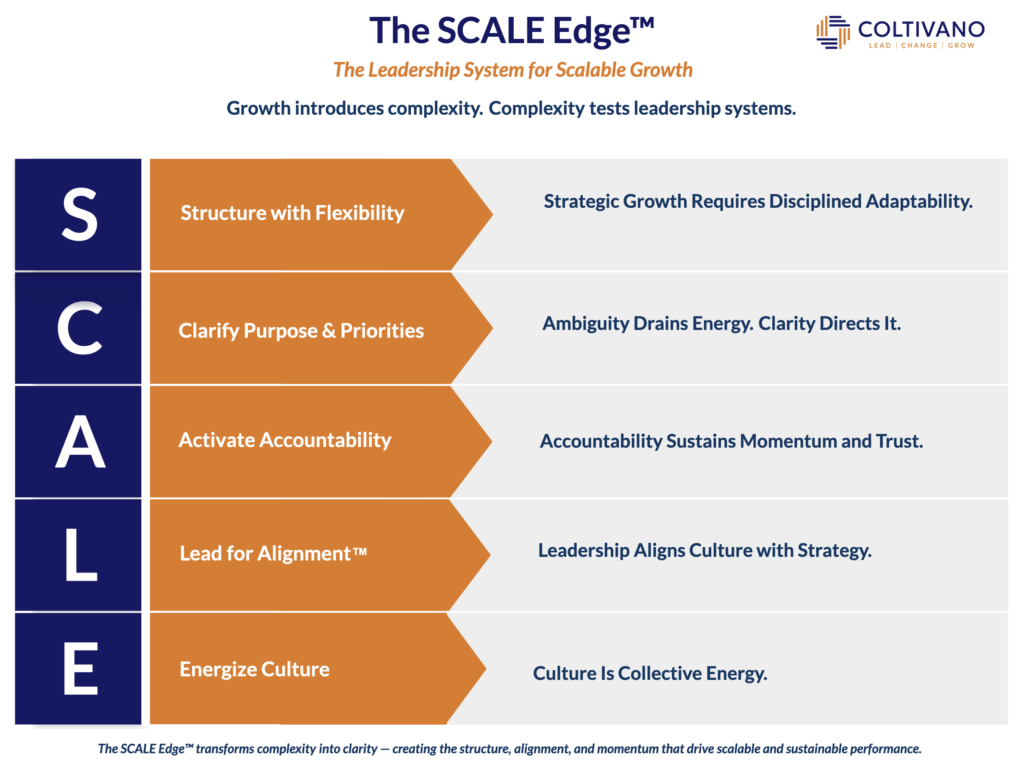
Within The SCALE Edge™, The Leadership System for Scalable Growth, these disciplines are expressed through structure with flexibility, clarity of purpose and priorities, activation of accountability, leading for alignment, and energizing culture as complexity rises.
AI does not introduce new leadership principles. It amplifies the consequences of neglecting them.
The Shift, Clearly Stated
AI expands what organizations can analyze and execute. It does not automatically strengthen the shared judgment required to align around what matters most. In the age of AI, leadership effectiveness depends on the ability to create clarity, sustain confidence, and coordinate aligned action when information moves faster than collective interpretation.
Organizations that scale AI successfully will not be those with the most advanced systems alone, but those whose leaders evolve the structures and disciplines required to translate accelerated insight into sustained, aligned performance.
An Invitation
AI reveals what must evolve next. As AI expands the demands placed on leaders, leadership systems must evolve to strengthen both structural discipline and leaders’ capacity to exercise judgment, sustain confidence, and create shared direction that translates capability into performance.
For leadership teams navigating this shift, the question is not whether AI will scale, but whether judgment and coordination will scale with it.
If that question feels timely in your organization, explore how Coltivano helps leadership teams meet the demands AI introduces with clarity, alignment, and conviction.
→ Start the Conversation
→ Explore The Coltivano Executive Intensive™